December 20, 1935 – September 25, 2022
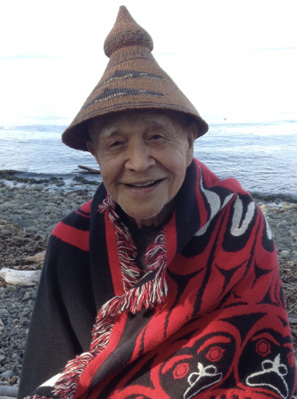
Earl “Cla-chum-se-nup” Smith was born at Saltery Bay on Nootka Island in 1935. He was the sixth of 18 children, and two of his siblings were adopted by his parents.
Earl spent happy childhood days in his mother’s Nuchalaht village. His ancestors had lived there continuously for more than 6,000 years. His parents, Esther and Joe, worked hard in canneries, logging camps, and wherever work could be found along the coast. Earl and his siblings were cared for by their large extended family. During those years, he learned the stories and language of his Nuchanulth culture.
His father was descended from the line of ranking chiefs of Nootka Sound known as “Maquinna.” The name means “bearer of cooking rocks” and reflects high social standing and influence.
Earl’s father’s people are the Ehattesaht of Esperanza Inlet. His mother’s people are the Nuchalaht of Nootka Island. Together, they are two of the fourteen Nuchanulth Nations whose traditional territories stretch along the west coast of Vancouver Island. Earl had countless relatives among the Nuchanulth people, from Nootka Sound to the Makah in Washington State.
The Nuchanulth people were known for their seamanship and their skill at harvesting food from the sea. However, their traditional hunting and gathering way of life became endangered when wage employment was introduced through colonization.
At the age of seven, Earl and his siblings were taken by federal authorities and sent to Indian residential schools far from home. With quiet dignity, Earl spoke about his struggle to survive abuse and to hold on to his language during his time at Christie School in Tofino and later at high school in Kamloops.
At nineteen, Earl returned to Zeballos to work in the logging industry.
In 1976, he hosted the largest potlatch ever held on the west coast. Nearly 1,000 members of the Nuchanulth Nations gathered in his mother’s village on Nootka Island, where Earl had played as a child. The potlatch celebrated a new chief and the strength and resilience of his people.
In 1983, Earl was elected chief of the Ehattesaht band. He worked to preserve the language and stories of his people and to encourage pride in their heritage.
In the late 1970s, Earl moved with his parents to the Lower Mainland for work. There, he met his wife, Mary. Together, they returned to Vancouver Island to be close to Earl’s large family, and Mary’s family later followed.
In 2019, Earl and Mary moved into their home at 1439 Seaview Road. They enjoyed visits from family, and the laughter of children often filled their home.
In his later years, Earl enjoyed walking in the neighbourhood and making new friends.
Earl has returned to the arms of his ancestors and the spirits of his Nuchanulth homeland. He is celebrated, honoured, and deeply missed by his beloved wife Mary and by his extensive community of family and friends.
Rest in peace, Earl.
Leave a Reply